
Structural Concept
The First Fair Value Gap (First FVG) represents the initial imbalance created immediately after a liquidity sweep and displacement. This research examines whether the first imbalance following a structural shift provides statistically meaningful directional bias within intraday session behavior.
Unlike conventional FVG usage, this model focuses exclusively on the first imbalance following a confirmed liquidity event, hypothesizing that it reflects algorithmic re-pricing rather than passive retracement zones.
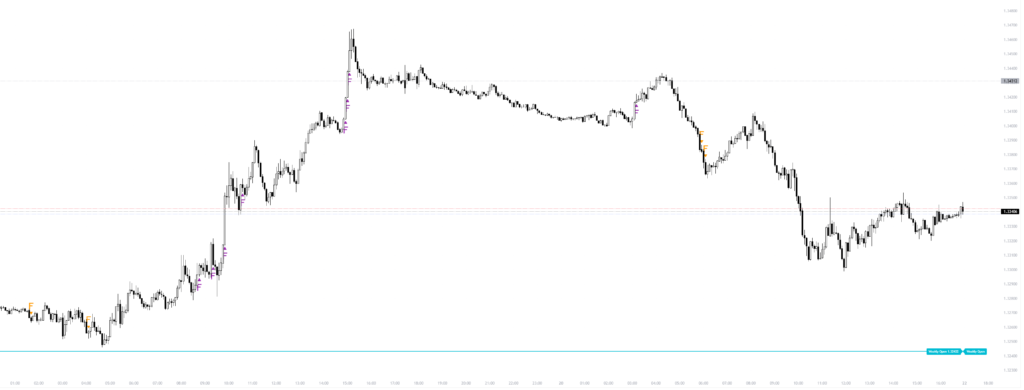
Observed formation of first imbalance following liquidity sweep.
Conceptual Definition
First FVG is defined as:
The first Fair Value Gap formed immediately after a liquidity sweep and displacement confirming structural intent.
This excludes:
- Late-session FVGs
- Pullback-generated FVGs
- Nested internal imbalances
The objective is to isolate the initial algorithmic repricing event.
Structural Sequence
The model assumes the following sequence:
- Liquidity Pool Identified (BSL / SSL)
- Liquidity Sweep Occurs
- Displacement Candle Forms
- First FVG Appears (Target)
- Price Retraces into First FVG
- Continuation / Expansion
This differs from traditional ICT usage where multiple FVGs are considered equally valid.
Bullish Example
- Sell-side liquidity swept
- Strong bullish displacement
- First bullish FVG forms
- Retrace into gap
- Expansion higher
The first imbalance represents the algorithmic transition from accumulation to distribution.
Bearish Example
- Buy-side liquidity swept
- Bearish displacement
- First bearish FVG forms
- Retrace into gap
- Expansion lower
Later FVGs often represent continuation rather than initiation.
Why Only the First FVG?
Later imbalances often occur during:
- Trend continuation
- Volatility clustering
- Reactive liquidity
The first imbalance is unique because it follows:
- Liquidity removal
- Structural shift
- Displacement confirmation
Thus it is more likely to represent algorithmic repricing.
Session Context Importance
First FVG reliability increases when formed within:
- London Killzone
- New York Killzone
- Post-Asia liquidity sweep
- Pre-expansion environment
This suggests session-based algorithmic activation.
Displacement Requirement
A valid First FVG must follow a displacement candle:
Characteristics:
- Large body relative to ADR
- Break of micro structure
- Close beyond liquidity level
- Minimal wick overlap
Weak displacement reduces statistical reliability.
Invalid First FVG Conditions
The model excludes:
- FVG formed before sweep
- FVG inside consolidation
- Multiple FVGs without displacement
- FVG formed during low volatility session
These conditions indicate passive liquidity rather than structural transition.
Observed Behavioral Pattern
Common behavior:
First FVG → shallow retrace → continuation
Later FVG → deeper retrace → noise
This suggests the first imbalance is closest to the algorithmic repricing origin.
Relationship to MSS
First FVG typically appears:
Immediately after external MSS
Not internal MSS
This reinforces its role in structural transition rather than micro correction.
Statistical Hypothesis
Hypothesis:
The first imbalance following liquidity sweep has higher continuation probability than subsequent imbalances.
Ongoing research examines:
- Session dependency
- Pair dependency
- Volatility regime influence
Practical Application
Entry model:
- Identify liquidity sweep
- Confirm displacement
- Mark first FVG
- Wait for retrace
- Enter continuation
Stop placement:
- Below displacement origin
- Beyond opposite liquidity
Model Limitations
The First FVG model may fail during:
- News-driven volatility
- Range-bound sessions
- No displacement environment
- Multiple liquidity sweeps
These conditions disrupt algorithmic sequencing.
Conclusion
The First FVG model isolates the initial imbalance created during structural transition.
By focusing only on the first repricing gap, the model attempts to distinguish algorithmic intent from reactive liquidity.
Ongoing statistical research aims to validate continuation probability across sessions and instruments.
Related Research: