
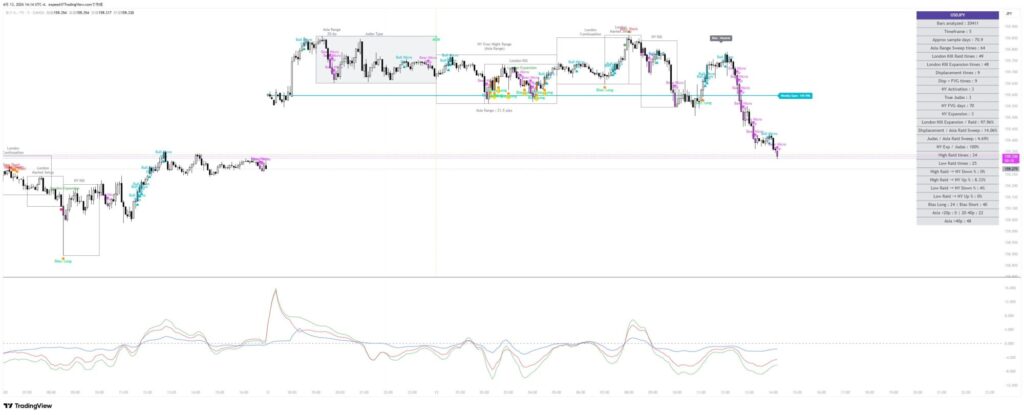
This model does not predict price direction.
It identifies whether the market is ready to deliver.
■ Introduction
In traditional macro trading, the U.S. Dollar Index (DXY) is often used as the primary benchmark for evaluating USD strength.
However, in intraday execution—particularly within session-based frameworks such as London and New York—DXY presents several limitations:
- It may lag real-time price delivery
- It is not always accessible or consistent across platforms
- It lacks execution-level granularity
As a result, relying solely on DXY can lead to delayed or misleading interpretations.
This research introduces a USD Proxy Model, designed as a faster, execution-grade alternative for evaluating USD strength—specifically in relation to XAUUSD.
■ The Concept of a USD Proxy
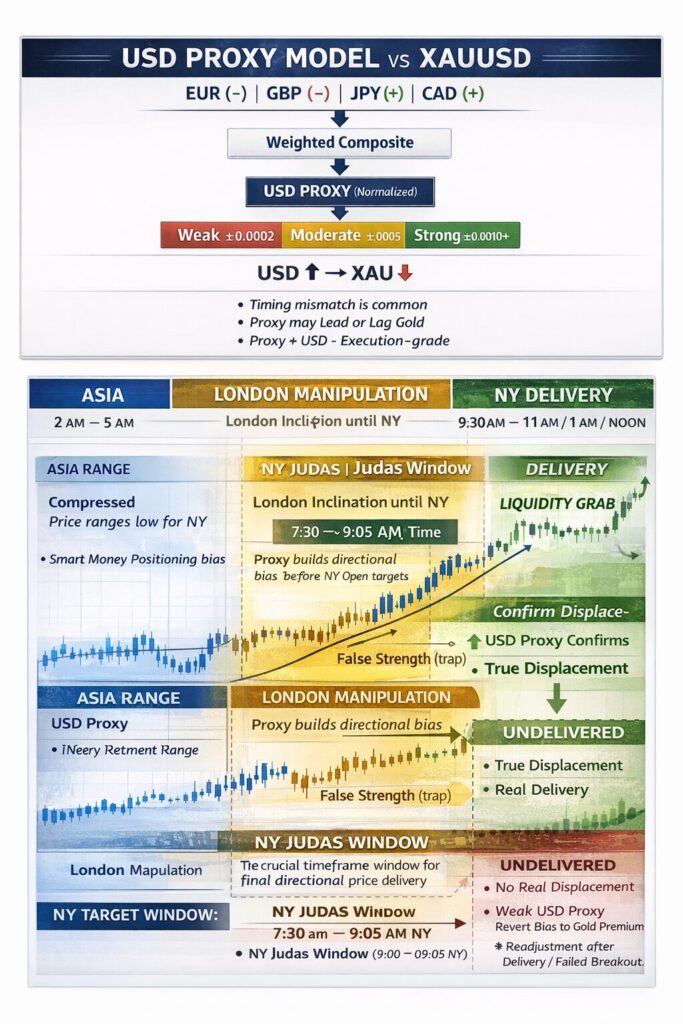
The USD Proxy is constructed as a weighted composite of major currency pairs, designed to approximate real-time USD strength.
Typical components include:
- EURUSD (inverse weight)
- GBPUSD (inverse weight)
- USDJPY (direct weight)
- USDCAD (direct or adjusted weight)
Rather than attempting to replicate DXY perfectly, the objective is:
To capture intraday USD behavior in a way that is usable for execution.
■ Proxy vs DXY
- Proxy = Intraday bias (fast)
- DXY = Macro alignment (slow)
Interpretation
- Proxy leads → early positioning
- DXY confirms → true strength
- Divergence → potential trap
■ Proxy Strength Classification
To make the model actionable, the Proxy is normalized and categorized into strength levels:
- ±0.0002 → Weak
- ±0.0005 → Moderate
- ±0.0010 → Strong
- ±0.0020 → Extreme
These thresholds allow traders to quickly assess whether USD movement is:
- Noise
- Transitional
- Directional
■ Relationship with XAUUSD
Gold (XAUUSD) typically exhibits an inverse relationship with the U.S. Dollar:
- USD Strength → XAU Weakness
- USD Weakness → XAU Strength
However, the relationship is not always synchronous.
Three key behaviors are observed:
- Proxy Leading Gold
→ Indicates early positioning or institutional accumulation - Gold Leading Proxy
→ Suggests reactive movement or liquidity-driven price action - Divergence
→ Often associated with traps or incomplete delivery
Understanding when and why these occur is more important than the correlation itself.
■ Session-Based Behavior
The effectiveness of the Proxy varies significantly across sessions:
Asia Session
- Low volatility
- Proxy signals are unreliable
- Market is typically in accumulation
London Session
- Increased volatility
- Higher probability of false strength
- Proxy divergence is common
New York Session
- Directional clarity improves
- Proxy aligns with price delivery
- Most reliable for execution
This aligns with the concept of liquidity delivery cycles, where New York often finalizes directional intent.
■ Practical Interpretation (Execution Context)
While the Proxy is not a standalone system, it can be integrated into a broader framework:
- Strong Proxy + NY displacement → continuation bias
- Weak Proxy during London expansion → potential reversion
- Divergence → caution / trap scenario
The key principle is:
The Proxy provides context—not signals.
■ Limitations
- The Proxy is not identical to DXY
- Weighting schemes affect output behavior
- Lag and noise still exist
- Macroeconomic events can invalidate intraday models
This model should be treated as a supplementary analytical tool, not a predictive mechanism.
■ Conclusion
The USD Proxy Model offers a practical way to interpret dollar strength within an intraday, session-based framework.
Rather than relying on delayed or generalized indices, this approach focuses on:
- Speed
- Structure
- Execution relevance
Ultimately, the goal is not to predict the market, but to better understand:
How and when price is being delivered.
“This model is not designed to predict price. It is designed to understand whether price is ready to move.”