
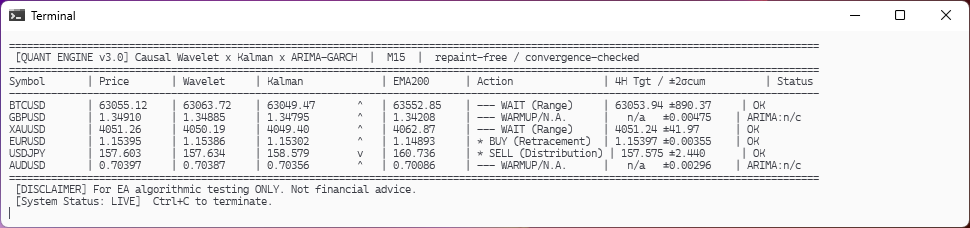
This page presents the quantitative models used by the eXpeed Research Lab to describe price behaviour in statistical terms. Where the structural models describe where liquidity events occur, these mathematical models describe how much a series moves and how noisy that movement is. Each model is treated as an observational tool, not a predictive guarantee.
Wavelet Transform
Multi-resolution decomposition (db4) with a data-derived universal threshold, used to separate trend structure from high-frequency noise causally.
State EstimationKalman Filter
Recursive Bayesian estimation of a latent trend level from noisy observations, providing an alternative structural reference line.
Conditional MeanARIMA
Models the directional component of a return series. Reported honestly as a near-random-walk baseline at short horizons.
Conditional VarianceGARCH
Models volatility clustering and produces the sigma bands used for range and Value-at-Risk assessment, including MS-GARCH extensions.
Direction and volatility are treated as two separate problems: ARIMA addresses the conditional mean, GARCH the conditional variance, while Wavelet and Kalman provide smoothed reference lines. Empirical results — including those that did not work — are reported as observed.